Saturday, 9 July 2011

Heraldry at Monknewtown, Co Meath - Roche family?

Monknewtown is close to the Meath-Louth border on the Slane to Drogheda route.


The coat of arms bearing three fish appears to resemble the arms of the Roche family.


http://www.slanehistoricalsociety.com/index.php?option=com_content&view=article&id=47&Itemid=54

The inscriptions from the graveyard are accessible on the link to the Slane Historical Society. The name of Roche however does not appear among them.

Tuesday, 5 July 2011

Heraldry at Kilruddery House, Brabazon family

Kilruddery House near Bray, Co Wicklow provides a treasure trove of heraldry. here we will concentrate on the multiquartered coat of arms proving the length families go to in rcalling their illustrious ancestors. Many of the associated families arms are also on stained glass at Bray Hall some of these images also follow.


The multi-quartered arms at the landing of the stairs date from 1684-1704 and these are for Edward Brabazon, 4th Earl who married first to Cecilia Brereton. We know this from the presence of the Brereton shield that is superimposed. This is known as an inescutcheon of pretence for the wife’s arms. There are sixteen other quarters and the arms represent the important families from the pedigree. The Brabazon arms appear twice thus leaving fourteen more to be accounted for.


The Brabazon arms follow:


The arms in the centre, the inescheuton of pretence is for Brereton


Five Quarters associated with Brabazon marriage


The five families are Clifford, Jervis, Hawberk, De Bisset and Moseley all whose arms also appear at Bray Hall.
(Assume the generations are successive going back in time)
Chamber, 5th Earl married 1682 Juliana, only daughter and heiress of Patrick, 2nd Viscount Chaworth.
 (Edward, 4th Earl, a brother, married first Cecilia Brereton and secondly Dorothea Stopford.     
 William, 3rd Earl, brother married 1671 Elizabeth, daughter of Francis Lennard, Lord Dacre.) 
Edward, 2nd Earl married 1682 Mary, daughter of Calcot Chambre of Denbigh Wales and Carnowe, Co Wicklow.
William, 1st Earl married 1607 Jane, daughter of Sir John Bingley
Sir Edward Brabazon, Lord Ardee (1616) married Mary Smyth of Mitcham, Surrey
Sir William Brabazon married Elizabeth, daughter of Nicholas Clifford
John Brabazon married Chawort
John Brabazon married Maud, daughter and heiress of Nicholas Jervis
Nicholas Brabazon living in 23 Henry VI married daughter and heir of Hawberk
John Brabazon was a commander for Edward III, m. a daughter of Harcourt
Thomas Brabazon
Sir William Brabazon married Joan Trussel
Matthew Brabazon
Sir Roger Le Brabazon married Beatrix De Bisset
Thomas Brabazon married Amelia Moseley


Clifford


Jervis (Brabazon impaling Jervis)


Hawberk


De Bisset


Mosely

Five Quarters associated with Clifford marriages

The five families are Savage, Clare, Vipont, Ewais and Cundi.

Elizabeth Clifford married first to Sir William Brabazon, father of Sir Edward, Lord Ardee and grandfather of William, 1st Earl of Meath, Elizabeth was heir of:
Nicholas Clifford who was of Sutton-Valence
Lewis Clifford succeeded to the Manor at Kent and was Sheriff of Kent in 13th Year of Henry VII reign.
Alexander Clifford (Kent) married Margaret, dau. of Walter Colepeper, died in 1494.
Lewis Clifford (Bobbing Court, Kent) married Anne, daughter of Lord Molynes.

William Clifford married Eleanor Savage, daughter of Sir Arnold Savage of Bobbing Court. William died in 16th year of Henry VI.
Lewis Clifford who in 31 Edward III (1358) was made a Knight, he was married to Eleanor, daughter of John Lord Delawar.
Roger Clifford who married Maud, daughter of Thomas de Beauchamp, Earl of Warwick.
Robert Clifford, born on All Saints Day 1305, was married 2 Edward III (1327 + 2) to Isabel, only daughter to Maurice, Lord Berkeley

Robert Clifford, born about Easter 1274, was slain at the Battle of Stirling or Babbockburn in 1314. He married Maud, daughter and coheir of Thomas de Clare.
Roger Clifford married Isabel, daughter and coheir of Robert de Vipont, Lord of Westmoreland
Roger De Clifford married Sibill, daughter and heir of Robert de Ewias
Walter De Clifford who lived in the reigns of Richard I, John & Henry II married Agnes, daughter Roger, son of Osbert de Cundi, Lord of Covenby. Walter was Sheriff of Herefordshire and died about 1223.

Savage


Cundi


Ewyas


                                                                            Clare


                                                                          Vipont

Two Quarters coming from the Vipont line

Roger Clifford married Isabe Vipont, daughter and coheir of Robert de Vipont, Lord of Westmoreland.
Robert Vipont’s wife was Isabel FitzGeoffrey,
and she in turn was daughter of John FitzGeoffrey and Isabel Bigod. Isabel Bigod was a daughter of Hugh le Bigod, 3rd Earl of Norfolk [lived c. 1186-1224]).
John FitzGeoffrey was son of Geoffrey FitzPeter.


FitzPeter


Bigod

Two Quarters coming from the Savage line

William Clifford married Eleanor Savage, daughter of Sir Arnold Savage of Bobbing Court. William died in 16th year of Henry VI.
Sir Arnold Savage is presumably descended from Sir John Savage (died in 1386) and Margaret Daniers daughter of Thomas Daniers. This marriage is on the pedigree at Kilruddery.
‘Sir Thomas Danyers of Bradley within Appleton, Knight, who died AD 1354 was present at the Battle of Cresey the XIVth day of May 1346 and there he rescued the Standard of Edward the Black Prince from the hands of the enemy, and made prisoner the Comte de Tankerville, Chamberlain of the French King.’ From a memorial at Grapplehall, Cheshire. 
The arms of Sir John Savage’s grandfather, Thomas Savage on the Kilruddery pedigree are quartered bearing the last quarter still remaining to be identified! They are likely to be the arms of Thomas Savage’s mother.

Daniers


Likely arms of Thomas Savage's mother ?

Saturday, 2 July 2011

Durrow Heraldry

The lodge house at Durrow, Co Offaly carries the Toler crest.


Toler crest: On a Ducal Coronet a Fleur-de-lis Or

Further information on Graham-Toler of Durrow Abbey see:

Friday, 1 July 2011

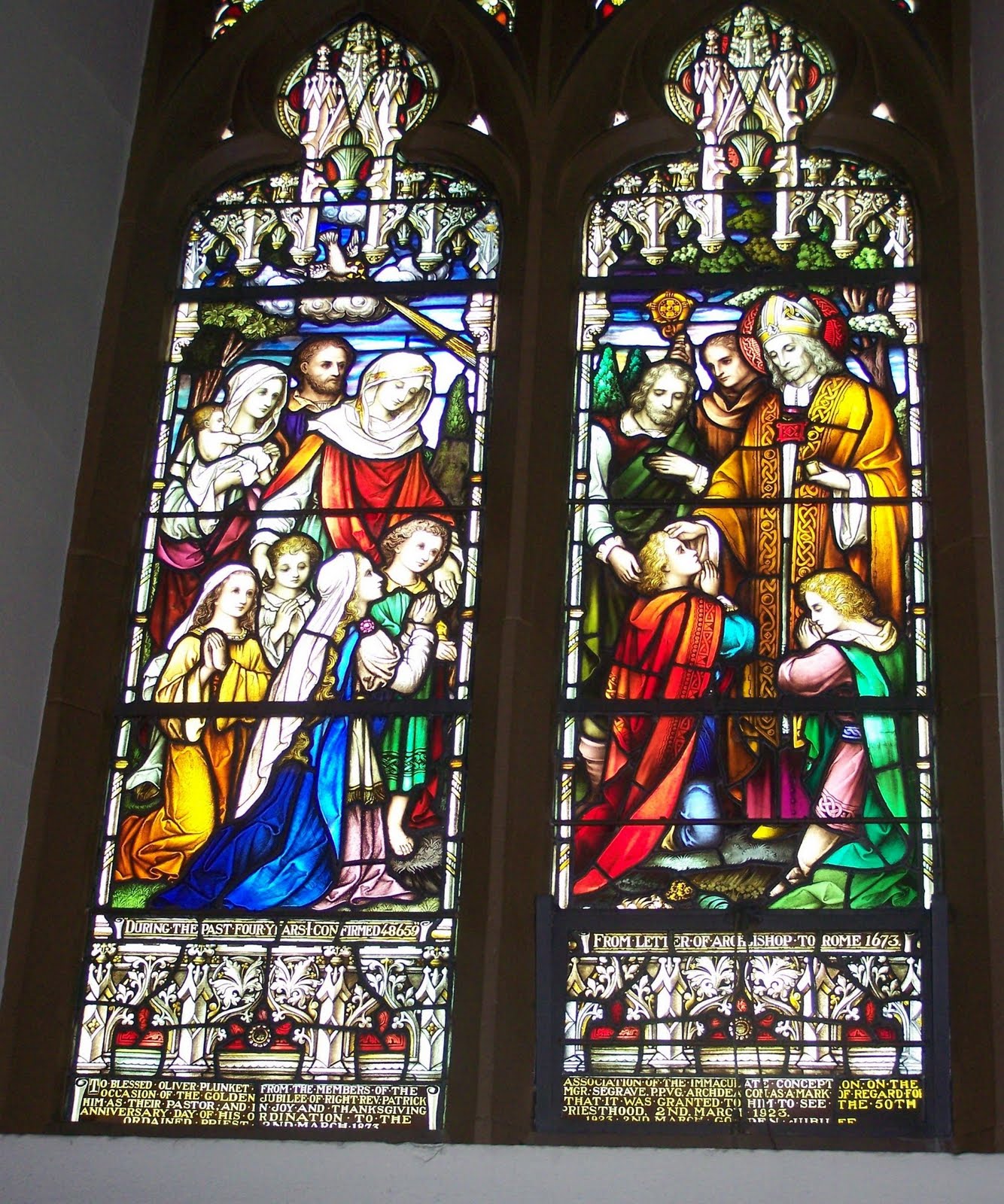
St Oliver Plunkett Heraldry

Today (July 1st) is the usual day that St Oliver Plunkett's feast is celebrated but this year the Feast of the Sacred Heart is today, so Oliver's feastday was celebrated yeserday. Oliver Plunkett (1625-81) was beheaded at Tyburn on 1 July 1681 mainly because he was not willing to compromise on his faith.

See also:

http://www.saintoliverplunkett.com/

[This Drogheda website offers plenty of information on St Oliver]

http://fatherdirector.blogspot.com/

[This blog of Fr John Hogan of the Fraternity of St Genesius offers a broader context in his reflections on the Irish Martyrs]

The reliquary still at the Siena Convent that contained his head until 1921 bears the Plunkett arms on the silver plate of the door.


A stained glass window at St Peter's Church, West Street, Drogheda also bears the arms and image of Oliver


The arms are also on the choir balcony at St Peter's along with those of Corker, Sheldon and Cotton.

Wednesday, 29 June 2011

Heraldry at Tandragee

The beautiful stained-glass window at Tandragee bears the full achievement of arms of the Duke of Manchester.


Arms:

Quarterly: 1st and 4th, Argent three Lozenges conjoined in fess Gules within a Bordure Sable (Montagu); 2nd and 3rd, Or an Eagle displayed Vert beaked and membered Gules (Monthermer)

 Crest:

A Griffin's Head couped wings expanded Or gorged with a Collar Argent charged with three Lozenges Gules

Supporters:

Dexter: an heraldic Antelope Or armed tufted and hoofed Argent; Sinister: a Griffin Or gorged with a Collar as in the Crest

Motto:

Disponendo Me, Non Mutando Me (By disposing of me, not by changing me)


Tuesday, 28 June 2011

Galway 'Browne Gate' Heraldry

The well known landmark, the Browne Doorway now at Eyre Square, Galway was removed from an old house in Lower Abbey Gate Street and it bears the names of Martin Browne and Mary Linch along with the date of 1627. 


On the left hand side are the arms and crest of the Browne family and on the right are the impaled arms of Lynch and Penrice with the Lynch crest on top. The arms of Browne are ‘argent an eagle displayed sable’ while those of Lynch are given by ‘azure on a chevron between three trefoils slipped or’.
The Penrices of Galway bore two coats, usually quartered when marshalled with other coats. These were ‘per pale indented argent and gules’ and ‘azure three lions passant argent’. The Browne arms are ‘or an eagle displayed with two necks sable’.


Sunday, 26 June 2011

Heraldry at Springhill, Moneymore, Co Derry

Springhill house in Moneymore has been in the ownership of the Lennox-Conyngham family until they handed it over to the National Trust.


Three chairs at Springhill bear the families multiquartered arms

The first one shown here has the multiquartered arms of Conyngham impaling the quartered arms of Staples and Molesworth.


The quartered arms of Conyngham and Lenox

The quartered arms of Hamilton and Arran


The second chair bears the multiquartered arms of Conyngham impaling those of Arbuthnot as follows:


The multiquartered arms of Conyngham impale the quartered arms of Staples and Molesworth on one chair at Springhill while they impale the arms of Arbuthnot on another chair.

The multiquartered arms of Conyngham are:

1st and 4th [quartered: 1st and 4th argent a fesse chequy azure and gules, over all a shake fork sable for Conyngham, and in chief a lion rampant of the third (gules); 2nd and 3rd argent, a saltire indented vert, between four roses gules for Lenox]

2nd and 3rd [quartered: 1st and 4th gules three cinquefoils argent for Hamilton; 2nd and 3rd argent a lymphad sails furled sable, flagged gules for Arran]

Crests: 1. a unicorn’s head argent, armed sable; 2. a demi-lion rampant purpure, armed and langued argent.

Arbuthnot: three mullets and crescent

Staples: on a fess ermines three hurts two goats heads erased argent

Molesworth: vaire, a bordure gules charged with eight charged with eight cross crosslets argent


William Arbuthnot Lennox Conyngham = (1932) Mina Ethel Lowry

Sir William Fitzherbert Lennox Conyngham = Laura Arbuthnot

dau of John Staples (Lisson) and Harriet Molesworth


Friday, 24 June 2011

Belvedere Heraldry

The quartered coat of arms at Belvedere House poses an interesting question about the origin of the Rochfort family's arms.


The Rochfort arms are given as azure, a lion rampant argent.

It can often happen with quartered coats that the other quartering represents some heiress even going back to the 1300s say. The Lion is for Rochfort alright but I am not sure about the other quartering. Sometimes families had an 'ancient' coat of arms that they continued to carry in quartered form as well.


The following information from Denis O’Neill suggests the origins of the arms. The first mention of the Rochfort family was in the year 1243, when a family of French nobility named “de Rupe-Forti“settled in Ireland. The family name was hyphenated at that time as it was the result of a co-joining of two wealthy French houses, the house of de Rupe (now Roche) and the house of Forti (now Ford or Forde). The area around Avignon in France appears to be where the family name "de Rupi" originated though other sources place it further north. Avignon is not confirmed but the most likely origin of the Roche or "de Rupe" branch...little is known of the "Forti" family. An Intresting detail is the Irish version of the townland wherein they settled now called Gaulstown or in Irish "Baile na nGall" translates as "town of the Galls". Perhaps Gaul is the seat of the "de Rupi-Forte" family
The new family coat of arms shows clearly this union, with elements from both family arms merged to form a new family name, the name "de ROCHFORT"


The Earl of Belvedere By Denis O’Neill

A collection of poems and history about The Rochfort Family Of Gaulstown, Rochfortbridge

Written and compiled by Denis O’Neill, Beechwood Lodge, Gaulstown, Rochfortbridge,

Thursday, 23 June 2011

Heraldry at Hillsborough

The church at Hillsborough bears two coats of arms for the Hill family.


The coat of arms of Hill is given as sable on a fess argent between three leopards passant guardant or, as many escallops gules.

The motto is ‘Per deum et ferrum obtinui’, By God and my sword I have obtained.


Wills Hill, 1st Marquess of Downshire (30 May 1718 – 7 October 1793), known as the Viscount Hillsborough from 1742 to 1751 and as the Earl of Hillsborough from 1751 to 1789, was a British politician of the Georgian era.


The coat of arms dated 1774 also include the supporters Dexter:  a Leopard Or spotted Sable ducally gorged and chained Gules;  Sinister:  a Reindeer Gules attired unguled and plain collared Or

Viscount coronet bearing eight strawberry leaves (four visible) and eight silver balls (or pearls) around the rim (five visible).

Hillsborough Castle was the residence of the Governor of Northern Ireland from 1922-1973. Their arms can be seen on the building outside as follows:


The arms of Duke of Abercorn (1922-45)


The arms of Lord Granville (1945-52)


The arms of Lord Wakehurst (1952-64)


The arms of Lord Erskine of Rerrick (1964-68)


The arms of Lord Grey of Naunton (1968-73)

For more on Hillsborough and the Richhill connection see:


Sunday, 19 June 2011

Heraldry at Kildare

Walter Wellesley, Prior of Great Connell, Newbridge was appointed Bishop of Kildare on 1 July 1529. He died in 1539 and was buried in the priory.


In the 1800s the stones from the tomb were discovered. In 1971 the tomb was reconstructed in St Brigid's Cathedral in Kildare.


Wellesley Arms (Dangan, Co Meath, 1603) Argent on a cross sable five escallops argent.