Friday, 22 May 2015

Gore Booth Heraldry Lissadell - Drumcliff

This year sees the 150th Birthday of William Butler Yeats (1865-1939) being celebrated on June 13th 2015.

A week later the Society on its all-day excursion will visit some of the sites associated with the poet in Co Sligo and Parkes Castle will also be visited.


The well-known gravestone of Yeats at Drumcliffe

The recent visit of Prince Charles also focused attention on Co Sligo and the places associated with Yeats.


The Interior of St Columba's Church Drumcliffe


WB Yeats wrote his own epitaph in his poem “Under Ben Bulben” which describes the location and the church, the last three lines are inscribed on his tombstone:

Under bare Ben Bulben’s head
In Drumcliff churchyard Yeats is laid.
An ancestor was rector there
Long years ago, a church stands near,
By the road an ancient cross.
No marble, no conventional phrase;

On limestone quarried near the spot
By his command these words are cut:

Cast a cold eye
On life, on death.
Horseman, pass by!”

St Columba's Church, Drumcliffe

Further Information of Yeats 150 is found at:


It is claimed that St. Colmcille (Columba) founded a monastery in Drumcliffe ca.575 A.D., although modern scholarship now claims that a monastery was founded much later here.

The village of Drumcliffe (also known as Drumcliff) is famous for its Irish high cross dating to the 9th-10th Century that stands in the grounds of the former abbey. In addition, across the road from the church and high cross is the stump of a round tower. The monastery was plundered by Maelseachlain O'Rourke in 1187. 


Round Tower at Drumcliffe


High Cross at Drumcliffe (East Face).

On the east face are Adam and Eve, David cuts off the head of Goliath, above a lion. At bottom of the head is Daniel in the Lion's Den. The scene at the centre of the head may represent the Last Judgement. (Irish High Crosses with the figure sculptures explained by Peter Harbison, 1994, page 50). Some of this detail differs from that on the Duchas notice board at Drumcliffe.


High Cross at Drumcliffe, (West Face).

The three figures at the bottom could represent the Holy Family or Elizabeth, Zacharias and John the Baptist. Above the camel there is possibly the scene of the mocking of Christ. Below the head of the cross could be the holy family returning from Egypt and at the centre of the head is the Crucifixion (Harbison).


Lissadell House is a neo-classical Greek revivalist style country house,

The house was built between 1830 to 1835, and inhabited from 1833 onwards, for Sir Robert Gore-Booth, 4th Baronet (1784-1835) by London architect Francis Goodwin. In 1876, Sir Robert left the house and surrounding estate to his son, Sir Henry Gore-Booth, 5th Baronet.

The house was the childhood home of Irish revolutionary, Constance Gore-Booth, her sister the poet and suffragist, Eva Gore-Booth and their siblings, Mabel Gore-Booth, Mordaunt Gore-Booth and Josslyn Gore-Booth. It was also the sometime holiday retreat of the poet, William Butler Yeats. He made the house famous with the opening lines of his poem:


Yeats made the house famous with the opening lines of his poem:

'In Memory of Eva Gore-Booth and Con Markiewicz'

The light of evening, Lissadell,
Great windows open to the south,
Two girls in silk kimonos, both
Beautiful, one a gazelle.


Edward Walsh and Constance Cassidy with Prince Charles and Duchess of Cornwall at Lissadell on 20 May 2015


'In Memory of Eva Gore-Booth and Con Markiewicz'

The light of evening, Lissadell,
Great windows open to the south,
Two girls in silk kimonos, both
Beautiful, one a gazelle.
But a raving autumn shears
Blossom from the summer's wreath;
The older is condemned to death,
Pardoned, drags out lonely years
Conspiring among the ignorant.
I know not what the younger dreams--
Some vague Utopia--and she seems,
When withered old and skeleton-gaunt,
An image of such politics.
Many a time I think to seek
One or the other out and speak
Of that old Georgian mansion, mix
pictures of the mind, recall
That table and the talk of youth,
Two girls in silk kimonos, both
Beautiful, one a gazelle.

Dear shadows, now you know it all,
All the folly of a fight
With a common wrong or right.
The innocent and the beautiful.
Have no enemy but time;
Arise and bid me strike a match
And strike another till time catch;
Should the conflagration climb,
Run till all the sages know.
We the great gazebo built,
They convicted us of guilt;
Bid me strike a match and blow.


The coat of arms of Gore-Booth

This armorial that came on sale in 2013 could well be associated with Countess Markiewicz or rather her ancestors. The first quarter contains the quartered arms of Gore and Booth.

Booth: argent three boars heads couped sable
Gore gules a fesse between three crosses crosslet fitche or

Sir Nathaniel Gore married Laetitia Booth and their son

Sir Booth Gore (1712-17730 (1st Baronet) married Emilia Newcomen, daughter of Brabazon Newcomen and Arabella Lambert.

The arms of Newcomen are:
Argent a lions head erased sable langued gules between three crescents gules.

The arms of Lambert are argent threes roses gules and perhaps the arms in the quarter of green (vert) background and three gold roses (or) reflect those of Lambert. 

The arms containing the three birds could well be for Brabazon, eventhough the tinctures differ. 

PARKE'S CASTLE


Rising three storeys tall, in an idyllic setting on the banks of Lough Gill, Parke's Castle is a plantation a era castle. In 1610 Roger Parke completed his fortified manor house on the site of an earlier fifteenth-century O'Rourke castle. He kept the walls of the original bawn - a spacious pentagonal defensive area - and demolished the O'Rourke tower house in the centre. The stones of O’Rourke’s tower were used to build the three-storey manor on the eastern side, eventually adorned with mullioned windows and diamond-shaped chimneys.


Sunday, 17 May 2015

Heraldry at Skerries - Holmpatrick

The 7th Century writer, Tírechán, wrote that Inishpatrick off Skerries, was the first place on which Saint Patrick set foot on his return to Ireland as a missionary. It was near here, somewhere close to the mouth of the Delvin River, that Saint Patrick converted his successor Benignus, regarded as the first native Irishman to become a bishop.

Legend has it that when the saint arrived on the island he was accompanied by a goat which provided milk. From this island St. Patrick would come to the mainland to convert the people. While the saint was ashore on a missionary trip the people of Skerries visited the island and stole his goat. They killed, cooked and feasted on it. When St. Patrick came back to the island he found his goat missing. This made him very angry and in two giant strides he reached the mainland. The first step took him to the back of Colt Island, the second to Red Island where he confronted the people of Skerries.

They tried to deny having seen his goat but found the beast cried out from their bellies. When they told the saint the truth about his goat their voices returned.

In 1989, the 50th anniversary of the building, it was decided to commission a bronze goat's head and mount it on the wall hus giving St. Patrick back his goat. The inscription around the plaque reads "quid nostrum fuit reddituum est propter deum et necessarios amicos mcmlxxxix" which roughly translates as "that which was ours is restored on account of God and necessary friendship 1989".

See:

http://www.visitskerries.ie/st-patrick.html


The Goat's head at St Patrick's Skerries

A visit to the Church of Ireland at Holmpatrick sees some interesting heraldry.


The quartered arms of Wood impaling the arms of Taylor.

Woods: Or on a mount in base an oak-tree acorned proper.
Taylor: Ermine on a chief gules a fleur-de-lis between two boar's heads couped and erect or.


The east window carries the impaled arms of Woods (quartered) with Taylor for Hans Hamilton Woods and his wife Louisa Taylor. He was the son of George Woods and Sarah Hamilton, daughter of Hans Hamilton of Sheephill. As you'll see below the names of Wogan, Warren and Bruce occur in the Woods ancestry. The quartered arms of Woods, Wogan and Warren were listed. It is not immediately obvious to which family the red lion rampant is attributed. Variations of the arms of Bruce and Warren and even Woods carry a lion rampant. 

Details from Burke:


The monument to James Hamilton of Sheep Hill who died in 1800 in the 73rd year of his age. He was survived by eight sons and eight daughters.


The Hamilton arms and crest


The monument to Dixie Coddington of Holmpatrick who died 1728 in the 63rd year of his age.


The arms of Coddington - Gules a cross or, fretty azure between four trefoils slipped of the second.

For further details on the Woods and Hamilton Estates see:


Saturday, 16 May 2015

Heraldry at Hillsborough Hill Rich - Hill! Richhill

A visit to Hillsborough in Co Down is interesting from a heraldic point of view. The quartered arms of Hill feature around the town. 

The quartered arms feature Hill, Trevor, Rowe and Rowe representing various marriages as outlined below. It is interesting to note that the arms of Trevor and Mostyn are the same and eventhough the armory and heraldic sources don't mention this, Sir John Trevor married Jane Mostyn. Was it just a coincidence or were the Mostyne arms adopted by the Trevor Family. 

In the church are the quartered arms are on the monument to Arthur Hill 5th Marquess Downshire that impale the arms of his wife Georgina Balfour.

Arms of Hill:
Quarterly:  
1st, Sable on a Fess Argent between three Leopards passant guardant Or spotted of the field as many Escallops Gules (Hill);  
2nd, Party per bend sinister Ermine and Ermines a Lion rampant Or (Trevor);  
3rd, Gules a Cinquefoil Or (Rowe);  
4th, Argent a Chevron Azure between three Trefoils slipped per pale Gules and Vert (Rowe)

The arms of Balfour are:

Argent on a chevron engrailed between three mullets sable, a seal's head erased of the first.

Crest:
A Reindeer's Head couped Gules attired and plain collared Or

Supporters:
Dexter:  a Leopard Or spotted Sable ducally gorged and chained Gules;  
Sinister:  a Reindeer Gules attired unguled and plain collared Or

Motto:
Per Deum Et Ferrum Obtinui (By God and my sword I have obtained)


The quartered arms of Hill impale those of Balfour on the monument of Arthur 5th Marquis Downshire (1844-74) at the church in Hillsborough.

Rt Hon Michael Hill who was born c. 1672  married Anne Trevor, daughter of Sir John Trevor and Jane Mostyn, in 1690. He died in 1699. He was M.P. for Hillsborough [Ireland].

Their son was Trevor Hill, 1st Viscount Hillsborough was born in 1693 who married Mary Rowe, daughter of Anthony Rowe. He died on 3 May 1742. He was created 1st Viscount Hillsborough, co. Down on 21 August 1717, with a special remainder to heirs of his father.He  was created 1st Baron Hill of Kilwarlin, co. Down  on 21 August 1717, with a special remainder to heirs of his father.


The arms of Hill (1774) on the Church tower.

The present building stands on or near the site of a Church which was erected by Peter Hill in 1636 and destroyed by fire in the Rebellion of 1641. In 1662 Arthur Hill built again, under the guidance of Bishop Jeremy Taylor, who was a close personal friend. This structure was enlarged and beautified at enormous cost by Wills Hill, Earl of Hillsborough and First Marquis of Downshire, in whose lifetime the family reached the zenith of its wealth and greatness. The opening service was held on 22nd August, 1773. The old dedication to St. Malachi was retained.


The Hill arms dated 1636 and 1774 on the tower.

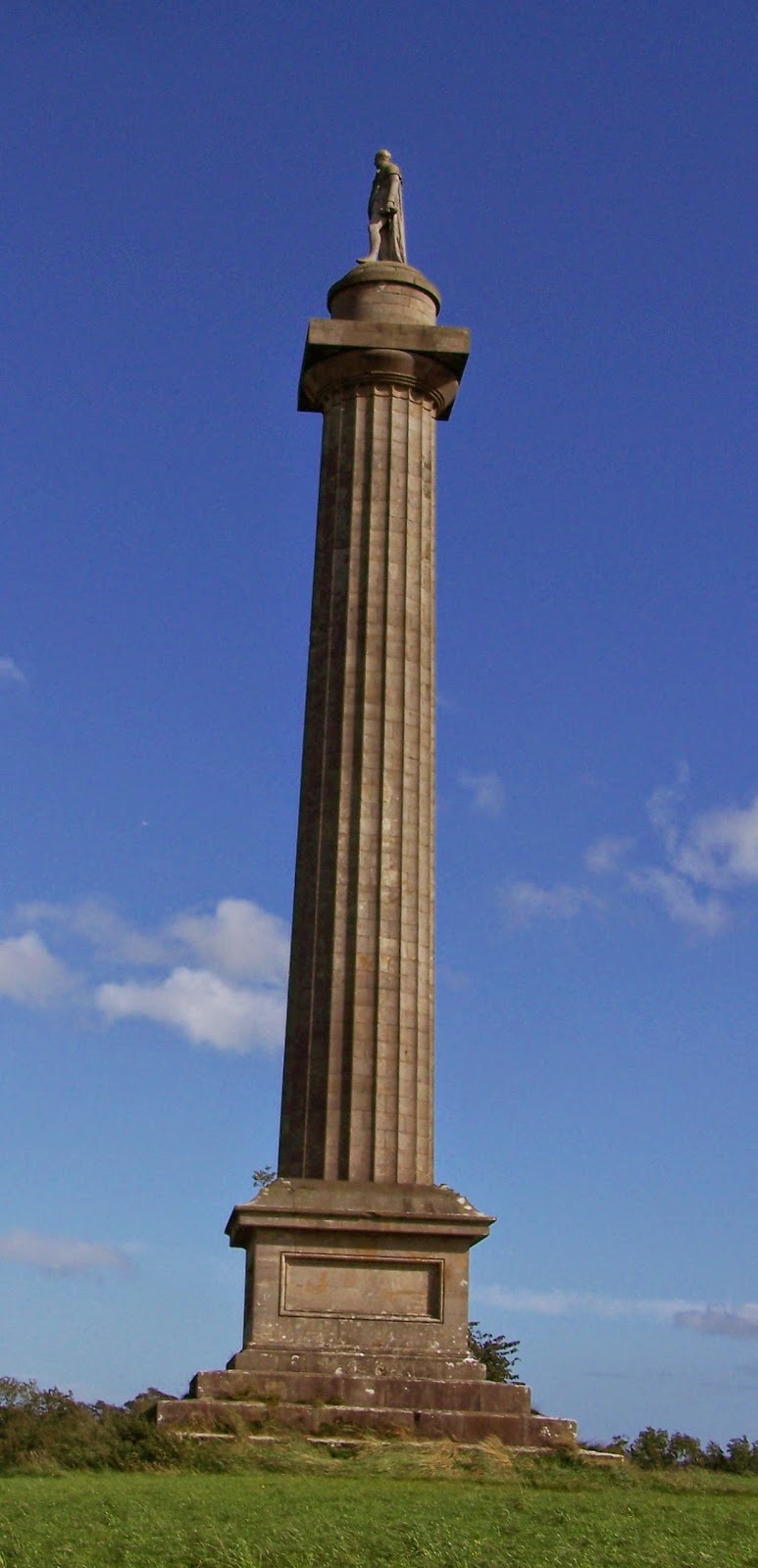
The tall monument is to the 3rd Marquis of Downshire.


The third marquis of Downshire.


Formerly known as "The Castle," the building was begun by Wills Hill, First Marquis of Downshire, and completed according to his plan in 1796, four years after his death. The architect was Brettingham. Later additions were made, notably by the Third Marquis, in 1843. Originally the present drawing-room portico was the main entrance, and opened unto the Moira Road, which then ran close to the house. The present Moira Road was laid down in 1826, and the intervening parcel of ground enclosed in 1841. This explains the presence of an old QUAKER BURIAL GROUND within the precincts to-day. The Castle has been the official residence of the Governor of Northern Ireland since 1922.

The gates and arms at Hillsborough came from Richhill and the quartered arms of Richardson and Sacheverell are on the gates.


Richhill Castle is a Grade A listed building, built by Major Edward Richardson, who also founded Richhill in 1665. The ornate gates were erected by his son William in 1745 and wrought by two brothers from Cornwall. They were seized in 1939 amid efforts to find metal for the war effort but were installed at Hillsborough Castle, where they still remain.


Richardson arms:
Sacheverall arms : Argent on a saltire azure five water bougets or, a chief or.

Richardson Crest: An armed arm holding a sword with a bush of thorns at the end all proper, pommel and hilt sable.


In 1610, as part of the Plantation of Ulster, the land was granted to Englishman Francis Sacherevall. His granddaughter Ann married Edward Richardson, who was an English officer, Member of Parliament for County Armagh from 1655 to 1696, and High Sheriff of Armagh in 1665. The original gates to the manor house were wrought by two brothers named Thornberry from Falmouth, Cornwall and were erected in 1745. In 1936 they were moved to the entrance of Hillsborough Castle

See an earlier post

http://irishheraldry.blogspot.ie/2011/06/heraldry-at-hillsborough.html


Thursday, 16 April 2015

Heraldry at Drumbanagher

The heraldry at Drumbanagher Church of Ireland, Poyntzpass, Co Armagh commemorates families that are related in various ways to the local Close family namely the families of Brownlow, Chamberlain and Maxwell. 


                                                           Drumbanagher Church

The heraldry on the various windows is described followed by the heraldic description and then a brief family pedigree of both Brownlow and Close show how the families are related.


In 1875 the stained glass windows in west wall were erected, the rose window in memory of Elliot Brownlow has the Brownlow crest and motto as shown:


                                                           Brownlow Crest

The two lancet windows of the west facing side were the gift of Dowager Lady Isham in memory of Sir Barry Close. These display the coats of arms, crests and mottos of both the Close and Maxwell families as shown:


                                                          Close arms, crest amotto


                                                     Maxwell arms, crest and motto


The monument erected in memory of Mary Sophia Brownlow and wife of Revd John Forbes Close who died on 6 May 1843 aged 39 bears the impaled coat of arms of Close with the quartered arms of Brownlow. The quartered arms of Brownlow are interesting in that along with the arms of Brownlow the arms of Chamberlain are also present reflecting the fact that Arthur Chamberlain (1645-1712) changed his surname to that of his mother, Brownlow. In 1903 the east window was erected in memory of Maxwell Close who died 25th January 1903 and it also bears the Close coat of arms as shown:


The impaled arms of Close with the quartered arms of Brownlow and Chamberlain.


                                              The Close coat of arms on the east window.

Heraldic Description

or = gold, argent = silver, sable = black, gules = red, azure = blue vert = green

Brownlow:    (Lord Lurgan) per pale or and argent an escutcheon within an orle of martlets sable.

Crest: On a chapeau azure turned up ermine a greyhound statant.

Motto; Esse quam videri (136).

Chamberlain: Gules a chevron between three escallops or (181).

Close:            (Drumbanagher, formerly Elm park, Co Armagh) Azure on a chevron argent between three mullets or, two buglehorns proper stringed gules with a stirrup iron in the centre rest proper.

Crest Out of an eastern crown or, a demi lion rampant vert holding a battle-axe headed argent.

Motto Fortis et fidelis (205)

Maxwell:        Argent a saltire sable on a chief argent three pellets sable.

Crest: A buck’s head erased proper. Motto Je suis prêt (672)

Chamberlain & Brownlow Pedigree

Arthur Brownlow (also Chamberlain) in 1667 carried out a brief survey of the several leases within the Manor of Brownlowes Derry, Co Armagh as well as of lands in Co Louth and Co Monaghan. He was born in Ardee Co Louth and entered TCD in Dublin graduating in 1664. The Brownlows Derry property was bequeathed by Sir William in 1660 to his daughter Letitia and then to her son Arthur Chamberlain who assumed the Brownlow surname. He appears to have been proud of his Anglo-Norman ancestry that he passed his Niselrath Co Louth property to his second son, Standish with the provision that he add the name of Chamberlain and quarter the arms of that family.

Patrick Chamberlain of Nealrath (Rathnestin) Co Louth married Letitia Brownlow daughter of Sir William Brownlow of Doughcoron

Arthur Chamberlain (1645-1712) later Brownlow of Lurgan  MP married in 1679 Jane Hartstonge daughter of Sir Standish Hartstonge baronet

William Brownlow (1683-1739) of Lurgan MP married 1711 Elizabeth Hamilton, daughter of James Hamilton of Donalong, 6th Earl of Abercorn

William Brownlow (1726-1794) married first in 1754 Judith Letitia Meredyth (died 1763) daughter of Charles Meredyth Dean of Ardfert.

Charles Brownlow (1757-1822) of Lurgan married in 1785 Caroline Ashe (died 1838) daughter of Benjamin Ashe of Bath.

Anna Brownlow (died 1863) married in 1820 Maxwell Close of Drumbanagher who was a Colonel and died in 1867.

Mary Brownlow married in 1822 John Forbes Close (Rector of Mourne) 


Maxwell & Close Pedigree

Robert Maxwell Bishop of Kilmore (Farnham Family)

Robert Maxwell

Henry Maxwell (Mullatinny, now Elm Park)

Margaret Maxwell (d. 1758) married Capt James Butler of Ringhaddy

Rev Samual Close married Catherine Butler of Ringaddy Co Down

Maxwell Close m (1748) Mary Maxwell, sister of John Lord Farnham

Rev Samual Close (Elm Park) m. Deborah Champagne: 4 of their children:

Henry Samual Close m. Jane Waring (Waringstown, Co Down)
John-Forbes Close m. Mary Brownlow
Maxwell Close born 1783 m. 1820 Anna-Elizabeth Brownlow
Mary Close m. Sir Justinian Isham

Maxwell Close 1827-1903 son to Henry Samual Close

Maxwell Close was born in Dublin in 1823.  His father Henry Samuel Close was a well-known lawyer and belonged to a substantial family of landed gentry in Drumbanagher in County Armagh.  From a very young age Maxwell Close displayed a more than usual interest in cultural heritage and thus we find him taking down songs and music from Pat Walker from County Wicklow as early as 1836.  He graduated from Trinity College Dublin in 1846 with a BA in Natural Sciences and in 1848 was ordained an Anglican priest, in which capacity he worked in England until, on the death of his father in 1861, he returned to Ireland. He died in 1903. A window at St Patrick’s Cathedral Armagh also commemorates Maxwell Close as shown:


                                       Close coat of arms at St Patrick’s Cathedral Armagh.


Drumbanagher Timeline


Wednesday, 15 April 2015

Rossnaree House - Heraldry - Osborne

On 19 August 2012, the Co Louth Archaeological and Historical Society had an enjoyable tour of Rossnaree House, thanks to Aisling Law.

Her website is well worth a visit

http://www.rossnaree.ie/house


Rossnaree House is a combination of Victorian and Italianate architecture. The front portion of Rossnaree was built by the Osborne family of Dardistown Castle, who owned the property from about 1720. They originally kept hounds on the site of the present house. In 1855 the Osborne's built the main building onto the huntsman’s modest dwelling.


The Osborne family crest at Rossnaree.

The motto is 'Pax in Bello' means 'Peace in War'.