Sunday, 16 November 2014

Heraldry in Tuam Cathedral (Assumption)


Heraldry in the Cathedral of the Assumption, Tuam

Originally an Article in JOTS 2009 (Journal of the Old Tuam Society)

The town of Tuam has its share of heraldry associated mainly with its two cathedrals. The heraldry in the Cathedral of the Assumption occurring mainly on the east window represents those associated with its building. The families involved are identified and discussed. The practice of heraldry dates back to Norman times when knights were clad in armour in battle and they put on a mail over the armour to distinguish between opposing armies in battle. This is a kin to modern hurling or football teams wearing jerseys so that team mates can easily identify each other and their opponents. The knights had various designs or patterns thus began the practice of heraldry and coats of arms. Later on heraldry took on a less practical use but it continued to be used by leading families to highlight their importance or their network of influential relationships in their local community.  


The Cathedral of the Assumption was built through the efforts of Archbishop Oliver Kelly (1815-34) who called a meeting on 18 March 1827 to discuss the possibility of building a new cathedral for the diocese. The meeting was held in Tuam’s first post-reformation Catholic Church built in 1783, and the decision was made to build a cathedral (Waldron, Tuam Herald). The foundation stone was laid on 30 April 1829. Archbishop Kelly lived to see the cathedral roofed and all but finished by the time of his death in 1834. Because it was not ready for use, Archbishop John MacHale (1791-1881) was enthroned in the old pro-cathedral. He supervised the construction of the tower and dedicated the completed cathedral on 18 August 1836 (Claffey, page 7). On the tower the arms of the Archbishopric of Tuam impale those of Hale or MacHale. It was common for bishops not to register their arms, Archbishop MacHale is not listed in the Armory as bearing arms but the arms that are on the tower are those of the Hale family of Alderley in Gloucester. The following inscription is also on the tower ‘IN HONOREM B.V.M. ASSUMPTAE ERECTAM DEDICAVIT DIE XVIII AUGUSTI A.D. MDCCCXXXVI JOANNES MACHALE ARCHIEPUS TUAMEN CATHEDRAM ISTRAM’.


Kelly Coat of Arms
 
 
MacHale (Hale) Coat of Arms


The East window referred to as the ‘great oriel’ window by Waldron portrays in centre the Virgin Mary with the child Jesus and also portrays the four evangelists with their insignia. Above these lie the arms of some of the subscribers to the cathedral. The window was made in Dublin and bears the date 1832. It is an early work of Michael O’Connor (1801-67) who began work as a heraldic artist (Claffey, page 24). O’Connor was an important figure in the early days of the gothic revival in stained glass working with such eminent figures as Pugin and Butterfield. He set up studio in Dublin and subsequently moved to London where his career was prematurely cut short by blindness but his sons continued the work (Lawrence, page 186). Waldron also noted that the window was badly damaged on the night of the ‘Great Wind’, 5 January 1839. The ten coats of arms on the window are namely from left to right, St George, Kirwan, Bellew, Browne, Tuam Archdiocese, Kelly, Talbot, Handcock, Maxwell and Burke. The Maxwell arms have been previously attributed to Newell. Most of the families were donors, some chose to remain anonymous and it is possible that some of the arms belong to them. The arms of Kelly represent Archbishop Kelly; Waldron describes the project of building a cathedral as his ‘magnum opus’. Beside the Kelly arms are the arms of the archdiocese surmounted by the archbishop’s hat and tassels. The heraldry allows us to identify some of the families not specifically listed as donors. The coats of arms are illustrated for ease of understanding of the heraldic terms.


East 'Oriel' Window at Tuam


St George and French


The St George coat of arms while named does not necessarily allow us to identify the particular family, the heraldry where the St George arms are quartered with those of French allows us identify the family as that of St George of Tyrone House near Clarinbridge. A quartered coat of arms usually has the arms of the husband in the first and fourth quarters and those often of an heiress in the second and third quarters. Arthur French of Tyrone married (1736) Olivia, eldest daughter of John Usher and Mary St. George, only daughter and heiress of George St. George, 1st Baron St. George of Hatley, Co Leitrim. Arthur died on 8 May 1779 and was succeeded by his eldest son, Christopher French of Tyrone, (born 1754) who in 1774 assumed the surname of St. George in pursuance of a direction contained in a settlement made by his grandfather, Baron St. George. He married in 1778 Anne, daughter of Henry Bingham of Newbrook. Their son Arthur French St George of Tyrone (1780-1844) married in 1801 Harriet St Lawrence and in 1811 the surname of St George was exemplified to Arthur French Esq. of Tyrone, on his assuming by royal license, the surname and arms of St George in lieu of French (Burke 888). This identifies the Tuam window as belonging to the St George (French) family of Tyrone House.


Arms of St George and French


Bellew and Dillon

The Bellew coat of arms at Tuam is impaled, this where the husband’s arms appear on the left hand side as viewed (dexter in heraldic terminology) and the wife’s arms appear on the right hand side (sinister). Christopher Dillon Bellew of Mountbellew who died in 1826 was particularly keen to cultivate an alliance with high profile figures working in the Catholic cause – a policy that his successors continued, culminating with a joint visit to Mountbellew by Daniel O’Connell and Archbishop John MacHale. Generous patronage on the church was in keeping with the paternalistic attitude and won the favour of Archbishop Kelly (Clarke, page 12). Michael Dillon Bellew, son of Christopher is listed by Waldron as one of the donors towards the cathedral. Michael Dillon Bellew was married to Helena Dillon, the eldest daughter of Thomas Dillon of Mount Dillon, Dublin and Eadestown, Co Kildare thus explaining the impaled coat of arms.


Arms of Bellew and Dillon


Handcock

Archbishop Kelly procured the site for the new Cathedral between St Jarlath’s College and the residence (later the Presentation Convent) of Mr. William Burke. The landlord was William Henry Handcock of Carrowntryla near Dunmore who owned much property in Tuam (Waldron). The site was obtained, initially on a rental basis from Handcock and on 10 February 1830 he agreed to a lease at a yearly rent of one shilling. In the Landed Estates website, Patrick Melvin notes that Carrowntryla was originally a Burke property, which was sold in 1753 to Anne Henry (widow of Hugh Henry, a Dublin banker, who died in 1743). It then passed to William Henry whose only daughter, Anne, married William Handcock in 1802. Both William Handcock's father and grandfather were clergymen (Landed Estates website). William Handcock married Anne Henry as his second wife, in October 1802. As he was a man of no fortune the Henry family opposed her right to the estate under the terms of the will. Handcock took the case through Chancery to the House of Lords. He achieved success in 1816 thus establishing the Handcocks at Carrowntryla. Anne died on 20 August 1818 leaving five children with William (Linley website). William Henry Handcock married Catherine Josephine Kelly and left 3 daughters at the time of his death in 1842 (Landed Estates website).


                                                                     Arms of Handcock

Browne


The Browne coat of arms is easily attributed to the Marquess of Sligo as the arms are for the Browne family and the coronet for a Marquess is also present. Waldron notes that in 1828 Archbishop Kelly sent Fr Nicholson to open an office in London and solicit subscriptions. Some of the amounts received through him were: Marquis of Sligo, £50; the Duke of Sussex, £10; Directors of the Bank of England, £25 also subscriptions from the Bishop of Norwich and the Marquis of Clanricarde, amounts not stated. Howe Peter Browne (1788-1845) of Westport House succeeded as 2nd Marquess of Sligo in 1809. He was married to Lady Hestor, sister to Ulick De Burgh, 1st Marquess of Clanricarde.


                                                 Arms of Browne (Marquess of Sligo)
Burke

The Burke coat of arms has no name beneath it; most likely the window honours William Burke of Corralea House, Tuam who died in 1834. He bequeathed much of his wealth to various charities thus enabling the Mercy and Presentation Sisters to establish convents adjoining the cathedral. He was also the subject of one of the statues in the church. Since the sculptor, Sir Thomas Farrell (1827-1900), had no likeness of William Burke on which to model his work, Tuam-born, Thomas H. Burke, then under secretary at Dublin castle acted as a model (Claffey, page 24). The statue now outside has a Latin inscription that recognises that William Burke donated ‘Corraghleach’ and is dated 1873. The absence of a coronet probably means that this window was not intended for Ulick John De Burgh, the Marquess of Clanricarde who was also noted by Waldron as a generous benefactor.


                                                               Arms of Burke
 

Talbot

The Talbot coat of arms is easily attributed to the Earl of Shrewsbury as his name appears beneath the window and the coronet for an earl lies above the coat of arms. With the succession of John Talbot in 1827 to his uncle’s title and property as 16th Earl of Shrewsbury and Waterford came immediate responsibility to Catholic missions historically supported by the family. He was the acknowledged leader of lay Catholicism in England (O’Donnell, page 11-12). He generously donated towards church building in England and in this country.


Maxwell (with Haggerston, Constable and Herries)


The Maxwell window at Tuam is a fine example of how heraldry can carry part of the family history in its coat of arms. The coat of arms has the Maxwell arms in the 1st and 4th quarters, the arms of Constable in the 2nd quarter and has those of Haggerston in the 3rd quarter. William Haggerston of Haggerston Castle (Northumberland) married Ann, daughter of Sir Philip Constable, 3rd baronet of Everingham in Yorkshire. Their grandson, William Haggerston assumed the name Constable upon inheriting Everingham. In 1758 he married Lady Winifred Maxwell, only child of John Maxwell, Earl of Nithsdale. Their son was Marmaduke William Constable (1760-1819). Upon his mother’s death in 1801, Marmaduke inherited the Maxwell property of Carlaverock (Drumfrieshire) and he assumed by royal license the additional surname of Maxwell (Burke, 327-8). Their son was William Constable Maxwell (1804-76) of Carlaverock and Everingham Park who became 10th Lord Herries of Terrgles (near Drumfries). He was responsible for building the Italianate Catholic chapel next to the house at Everingham. It was built by him in 1839 to celebrate Catholic Emancipation and he was likely to be a generous supporter towards Tuam.


                                    Arms of Maxwell (& Herries), Constable and Haggerston
 
The Maxwell arms in the 1st and 4th quarters are also interesting for they illustrate aspects of Scottish heraldry. Robert, 6th Lord Maxwell (who died in 1552) bore the Maxwell arms of a black (sable) saltire. His grandson, Robert, 10th Lord Maxwell (who died in 1646) or Earl Nithsdale bore the double-headed eagle with the saltire as inescutcheon ‘en surtout’ (superimposed) as it is displayed on the window at Tuam. In Scottish heraldry the inescutcheon ‘en surtout’ is the principal coat. The latter Robert’s sister, Elizabeth married John, 6th Lord Herries and their son, John 7th Lord Herries succeeded his cousin as 3rd Earl Nithsdale. He bore the same arms as his uncle, Robert 10th Lord Maxwell but now differenced with an urcheon (hedgehog) from Herries, his mother’s arms (McAndrew, page 391).
Kirwan
The arms of Kirwan are probably due to the work of James Kirwan of Gardenfield. Not alone did he work on the masonry in the Cathedral but he sourced all the materials himself save the scaffolding (Claffey, page 11). Claffey also notes that one of the finer features of the cathedral is its superbly-cut limestone ashlar that is to the eternal credit of Kirwan. The family were also landed gentry in the parish, the Gardenfield estate amounting to 1,843 acres was advertised for sale in the Encumbered Estates' Court in April 1854 by James and Robert Kirwan.
 
                                                                  Arms of Kirwan
 
The Arms of Tuam and Neary
 
In the year 2000, the coat of arms of Archbishop Michael Neary was beautifully crafted by Ms Ursula Klinger. The arms are on a 12 by 13 inch cedar and utile piece and were completed using enamels and oil paint by Ms Klinger. The modern arms of the Archdiocese of Tuam are on the dexter side while the personal arms of the Archbishop on the sinister side. The personal arms were used by him as Auxiliary Bishop. The modern arms of the Archdiocese bear the cross and broken wheel. The broken wheel is a reminder of the providential ‘breakdown’ of St Jarlath’s chariot as he journeyed through Tuam. The Book of Lismore provides a dialogue between St Brendan of Clonfert and St Jarlath, where Brendan interpreted a dream for Jarlath to go and build a community wherever his chariot wheel broke down (Claffey, page 5). The rays under the crossbeam symbolise the grace and light flowing from the cross of Christ. In common with Cardinal Brady and other Irish bishops, Archbishop Neary has adapted his existing family arms, in his case those of Neary and Gibbons to evoke Christian symbolism on his arms.
 
Arms of Tuam
 
 
Arms of Tuam (Modern) and Neary
 
The Neary and Gibbons arms each bear three annulets (rings). Two of the rings are transformed to represent the ancient Christian symbols, the sun representing Christ, the light of world and the moon representing the Blessed Virgin Mary and the Church. The central ring is an emblem of the wedding band of gold and its promise of fidelity. The Archbishops arms also reflect his family’s closeness and contribution to the Marion Shrine at Knock. The Marian theme is also central to the coat of arms where the Marian monogram (MR) at the base of the shield symbolises Mary, the Mother of God drawing the faithful towards her son. The monogram along with the lamb on the chief of the shield further develops this theme. The presence of the lamb at the apparitions at Knock evokes the Lamb of God who takes away the sins of the world and in turn draws our minds to the centrality of the sacrament of reconciliation at Knock. Above the coat of arms is the galero or archbishop’s hat with ten tassels draped on either side of the coat of arms. Behind the coat of arms lies the archiepiscopal cross.
 
The monument in the porch remembers the four Archbishops who are interred in the Cathedral: John MacHale (1831-81), John MacEvilly (1881-1902), John Healy (1903-18) and Thomas Gilmartin (1918-39). It also remembers the two most recently deceased Archbishops who are interred in the Cathedral grounds namely: Joseph Walsh (1940-69) who died in 1972 and Joseph Cunnane (1969-87) who died in 2001. The memorials to Archbishop Walsh and Archbishop Cunnane also bear the arms of the archdiocese along with their mottos ‘Dominus Adiutor Meus’ and ‘Familiam Dei Aedificare’ respectively. The monument in the porch along with the memorials outside also bear the galero, tassels and the archiepiscopal cross.
 
 
Arms of Tuam Modern
 
Coats of Arms
 
All the coats of arms apart from the latter two are taken from the General Armory and the page numbers are not given as the names are listed in alphabetic order.
 
Heraldic terms: argent = silver, azure = blue, gules = red, or = gold, sable= black, ermine is a type of animal fur, dexter = right (left as viewed by an observer) and sinister = left (right as viewed). Some of the other heraldic terms are technical and the photographs serve as a pictorial illustration.
Bellew             Sable, fretty or.
Browne           (Marquess of Sligo) Sable three lions passant in bend argent between two double cottises argent.
Burke             (Earl of Clanrickard) Or, a cross gules, in the dexter canton a lion rampant sable.
Dillon              Argent, a lion rampant between three crescents, an estoile issuant from each gules, over all a fess azure.
(Fitz)Gibbon  Ermine a saltire gules on a chief or three annulets or.
(Mac)Hale      Argent a fesse sable, in chief three cinquefoils sable.
Handcock       Ermine on a chief sable a dexter hand between two cocks argent armed.
Herries            Argent three urcheons (hedgehogs) sable.
Kelly               Azure, a tower triple-towered supported by two lions rampant argent as many chains descending from the battlements between the lions’ legs or.
Kirwan           Argent a chevron sable between three Cornish choughs proper.
Maxwell          (Constable-Maxwell, Lord Herries) Quarterly 1st and 4th argent an eagle displayed with two heads sable beaked and membered gules on his breast an escutcheon argent charged with a saltire sable and surcharged with an urcheon or for MAXWELL; 2nd quarterly gules and vair, a bend or for CONSTABLE; 3rd Azure on a bend cotised argent three billets sable for HAGGERSTON.
Neary/Nary    Gules on a fess argent, three spearheads gules, in chief as many annulets or.
St George       (Tyrone House) Quarterly 1st and 4th argent a chief azure, overall a lion rampant gules ducally crowned or for St George; 2nd and 3rd ermine a chevron sable for French.
Talbot             (Earl of Shrewsbury) Gules a lion rampant or, a bordure engrailed or.
Tuam              Azure three figures erect, in the middle the Blessed Virgin with a child in her arms, on the dexter side a mitred abbot, with the dexter hand giving benediction, with the sinister holding a crozier bendwise, on the sinister side St John holding his dexter hand upwards, and in the sinister a lamb, each in proper vestments, all or, hands and feet proper over each of their heads a piece of Gothic architecture or.
The following arms could be blazoned as:
Neary              Per fess gules and azure on a fess of the first fimbriated between in chief a lamb passant and in base the Marian monogram (MR) all argent, an annulet between on the dexter a sun and on the sinister the moon all or. Motto: Fidelis et Misericors
Tuam (modern)
Sable a Latin cross debruised in base by a broken wheel of ten spokes.
Bibliography
General Armory of England, Scotland, Ireland and Wales
by Bernard Burke, 1884
A Genealogical and Heraldic History of the Commoners of Great Britain and Ireland
by John Burke 1836 
The Cathedral of the Assumption: Tuam
by John A Claffey, 1986.
Christopher Dillon Bellew and his Galway Estates, 1763-1826
by Joe Clarke, 2003.
‘Nineteenth-century stained glass in the Church of Ireland diocese of Limerick & Killaloe’ Irish Architectural and Decorative Studies, The Journal of the Irish Georgian Society, Vol X, pages 132-199.
by David Lawrence, 2007.
 
Scotland’s Historic Heraldry
by Bruce McAndrew, 2006.
 
The Pugins and the Catholic Midlands
by Roderick O’Donnell, 2002.
The History of Tuam Cathedral
by John J. Waldron, Tuam Herald, Saturday 16 November 1968.
 
Websites
for St George and French
 
for Henry and Handcock
 
for Handcock
 
Acknowledgements
 
My thanks to Archbishop Michael Neary and Fr Fintan Monahan at the Archbishop’s House, Tuam for help with the Archbishop’s arms. Dr Tony Claffey (Tuam) provided invaluable advice pertaining to Tuam and Gerard Crotty (Fermoy) likewise in matters heraldic. I would like to acknowledge the kindness and help from the staff at the library in Tuam. Finally many thanks to Anne Tierney and the editorial team of the Old Tuam Society.


Friday, 14 November 2014

Purfield Stone at Ardcath, Co Meath


THE PURFIELD STONE

The Purfield stone in the graveyard on the north facing side of the ruined church in Ardcath is now broken and undecipherable but is worthy of record. In 2006 the tabletop gravestone (figure 1) was broken into about six parts, part of the first line of the inscription was still legible bearing the words ‘erected in memory of’. The beginning of the word ‘Dioc ...’ apparently for diocese was also identified in the inscription (figure 2). This is sufficient to allow the stone to be identified from the inscriptions given in Cogan’s 1862 history of the diocese. The stone is now further broken and the remaining inscription is also less decipherable. The inscription in question is given by Cogan (Vol. 1, page 338) as:


‘This stone was erected in memory of

the late Rev. NICHOLAS PURFIELD,

Vicar-general of the diocese of Meath,

and parish priest of Ardcath,

who departed this life the 16th day of October,

in the year of our Lord 1795,

and in the 65th year of his age.

Requiescat in pace.’
 
 
Figure 1: The Purfield gravestone at Ardcath in 2006.


Figure 2: The Purfield gravestone at Ardcath bearing the arms and crest of Purfield.The inscriptions on the gravestones of those other priests buried at Ardcath mentioned by Cogan do not have the same starting line as that of Purfield and they have all been accounted for except that of Pentony. As is often the case for priests, the inscription on this tabletop was written in the opposite direction to that on the remaining tabletops for the laity in the graveyard. The additional heraldic features of interest on this gravestone are still visible. The shield on the stone contains the Purfield coat of arms (figure 3), that depicts a cross. Above the shield the crest appears to be a heraldic tiger or wolf. The motto beneath the arms is no longer legible. While one would often expect the gravestone of a priest to carry a cross, the Purfield gravestone at Duleek provides further context for the heraldry at Ardcath. The Duleek stone bears the inscription ‘This stone and burial place belongeth to Richard Purfield and his posterity who depd this life the 16 of Febry in the year of Lord 1753 aged 53 years’. This gravestone also bears a cross for the arms of Purfield along with a cat for the family crest (figure 4). The motto ‘Spes meum cruce’ lies beneath the arms. As an aside the arms and crest at Duleek appear to resemble that of the Burke family though it may differ in tincture or colour. The Duleek stone also bears a four-leaved flower in two of the ‘quarters’ as shown in figure 4.


Figure 3: The shield at Ardcath bearing the Purfield arms with the family crest above.While the arms of an English branch of the Purfield family carry a chevron shape and three garbs it is obvious that this Irish branch of the Purfield family identified the cross as their arms as carved on stone at both Ardcath and Duleek. The Purfields were an important ecclesiastical family in Co Meath and Co Dublin and as recent as the 1901 census the Purfields are only listed in these two counties in Balbriggan and Gormanston (Stamullen) and in the city of Dublin. Rev Richard Purfield was parish priest in Saggart from 1714 to 1730 (Ball, volume 3, chapter 8). Fr Nicholas Purfield mentioned above was parish priest of Ardcath and died in 1795 from apoplexy. Cogan notes that he was vicar-forane of Meath and not vicar-general, as his tombstone states. He was master of conference for the deanery of Duleek. He was born in the neighbourhood and was cousin to Fr John Purfield of Duleek. Fr John Purfield was parish priest of Duleek for 71 years and died on 28 January 1797 aged 102 (Catholics and Catholicism in the Eighteenth Century Press, p. 301). Fr John Purfield who was born c. 1695 may have been a brother of Richard Purfield (born c. 1700) who was buried at Duleek in 1753 during his time as parish priest there. Cogan (Vol 2, page 235) states that Fr John Purfield was born of a respectable family which sent many zealous members into sacred ministry. Cogan contradicts the date of death given above and says that Fr Purfield died in July 1791 and was buried in the east end of the south aisle in the old church of Duleek concluding that he was nearly 100 years. Catherine Cavanagh (alias Purfield) who died 21 August 1812 aged 55 is also buried at Duleek, her son Richard erected the headstone (O’Boyle 2001, 140). Fr Nicholas Purfield was also cousin of another Rev Nicholas Purfield, a Franciscan friar at Courtown, Co Meath.

 
Figure 4: The Purfield arms, crest and motto at Duleek.

References:
 
Revd Anthony Cogan, The Diocese of Meath, Ancient and Modern (Dublin 1862), Vol. 1.
Available on Googlebooks: search ‘Ardcath Fr Purfield’.

Revd Anthony Cogan, The Diocese of Meath, Ancient and Modern (Dublin 1867), Vol. 2.
Available on Googlebooks; search ‘Fr Purfield died in July 1791’.

‘Catholics and Catholicism in the Eighteenth Century Press’ in Archivium Hibernicum, (published by The Catholic Historical Society of Ireland), Vol. 20 (1957), pp. 273-304. Available on JSTOR

Enda O’Boyle, Gravestone inscriptions from Duleek Churchyard, Ríocht na Midhe, 2001, Vol. XII, pp 129-55.

Francis Elrington Ball, A History of the County Dublin: The people, parishes and antiquities from the earliest times to the close of the 19th century. Published in six volumes (1902-1920).           http://www.chaptersofdublin.com/books/ball1-6/Ball3/ball3.8.htm

All the websites were accessed on 13 July 2011 and both volumes of Cogan’s History were available in full.

Wednesday, 15 October 2014

Louth Field Names Book Launch - 13 November 2014

The Louth Field Names Project launched the book:


The Field Names of County Louth.


on Thursday, 13 November 2014 at 8.00 p.m.

at Bellingham Castle, Castlebellingham,

by Ms Mairéad McGuinness, M.E.P.

 Copies are on sale at Carroll's Bookshop, Dundalk

Ardee Book Shop

Drogheda Bookshops.

Between December 2012 and April 2014 some 200 volunteers collected over 10,000 field names from all over County Louth. The book presents the project’s findings in a 400 page full colour publication. The book opens with a background to the project and a history of Louth’s fieldscapes. The project findings are presented in nine thematic chapters exploring field names connected with farming, the landscape, antiquities, folklore, rural industry and wildlife, as well as a discussion of Irish-language field names and rundale farming. The project findings are interspersed with diverse perspectives on Louth’s field names and landscape from heritage experts like Eanna Ní Lamhna as well as members of Louth’s farming community.

The Louth Field Names Project commenced in early 2012 under the auspices of the County Louth Archaeological and Historical Society, County Louth I.F.A. and the County Louth Library Service. It was funded mainly by Louth Leader along with some matching funding from generous sponsors. The training phase of the project was led by Ms Grace McCullen, Dr Eve Campbell was appointed co-ordinator in September 2013.

The book costs €20 


Tuesday, 30 September 2014

Heraldry and Inscriptions at St Brigid's Church, Beaulieu, Drogheda

This article first appeared in the Journal of Co Louth Archaeological & Historical Society (2013, Vol 28, No. 1)


The present Church of Ireland (St Brigid’s) at Beaulieu was built with a square two-storey tower in 1807 with the assistance of a gift of £600 from the Board of First Fruits. In 1955 the roof collapsed and had to be replaced. On the resignation of Revd Edward Groome, who had been rector from 1831 to 1872, Beaulieu was grouped with Ballymakenny parish, and in 1877 it became part of Termonfeckin union. The church is no longer used regularly for service. It is said that the remains of a pre-Reformation Archbishop, John Prene (1439-43), lie in a vault beneath the church (Fleming 2000, 228). The gravestone inscriptions to 1900 in Beaulieu churchyard are given in this Journal (1981, vol xx, no. 1, pp. 57-60) and the inscriptions post 1900 are given in the Journal of the Old Drogheda Society. The inscriptions appearing on the monuments and brasses inside the church follow:

 Alley

Sacred to the memory of the Revd Jerome Alley, L.L.B. for 37 years Rector, of the Parishes of Beaulieu and Drumcar in this diocese; a pious and learned minister of the Gospel. He was the author, of that able defence of the christian religion, “Vindiciæ Christianæ”: in the composition of which, he had been engaged for several years; he lived just long enough to see this work published; and died on the 21st May, 1827, in the 69th year of his age, relying on the consolations and promises, of that religion, which his pen had so ably vindicated. This Monument has been erected by the piety and affection of his son, Captn Wm. Hy. Alley, and of his grand-daughters, Sophia and Maria Alley, the only children of his eldest son, Captn. Holroyd Alley, deceased.


 Alley

Memoriæ Revdi Hieronimi Alley L.L.B., M.R.I.A., Nuper hujus parochiæ rector qui hâc vitâ decessit Die Maii XXI A.D. MDCCCXXVII et ætatis suæ LXXI. Sacerdotis Christiani officio fideliter functus per annos quandraginta et octo in spê certa gloriæ sempiternæ per Christum. Hoc monumentum dicatum est pro documento pietatis et reverentiæ. Filio ejus maximo natu superstiti Hieronimo Alley clerico parochiæ Sancti Andriæ in Novâ Brunswigia Rectore.

 
[To the Memory of Jerome Alley, L.L.B., M.R.I.A., late Rector of this Parish, who departed this life 21 May 1827, aged 71. He carried out the Christian priestly office faithfully for 48 years. In the certain hope of eternal glory through Christ, this monument was dedicated by his eldest surviving son, Jerome Alley, pastor of the parish of St Andrew, New Brunswick.]


Donagh

In memory of Francis Donagh, of Newtown, Co. Louth Esq J.P. An upright Magistrate, a munificent benefactor, and an humble Christian. Born 9th Aug. 1800, died 3rd Oct. 1885 aged 85 years. This tablet is here placed in grateful remembrance by his friend, Arthur Ellis                                                             J.P. W. Sawier, Dublin.

 Donagh


Sacred to the memory of Philip Donagh Esqr of Newtown, who died on the 14th of May 1820 in the eighty third year of his age, and was interred in this church yard. This monument is inscribed as a grateful record of a kind and affectionate parent by his only son, Francis Donagh.

 Donagh

To the glory of God and in memory of Francis Donagh Esqr of Newtown, Drogheda, died 3rd October 1885, erected by George Charles Smyth.

(on brass underneath the stained glass window)

 Donagh


In memoriam infra positi Philippi Donagh, hoc posuere monumentum seniores ejusdem filii Antonius et Lucas obiit 25o die Iunii 1721 ætatis anno 58. Laurana uxor Philippi supra memorati obiit quinto Marcii 1750 ætatis anno 80.

 [In memory of Philip Donagh, buried below, this monument was placed by his older sons, Anthony and Luke. He died 25th June 1721 aged 58 years. Laurana, wife of the above mentioned Philip, died 5th March 1750 aged 80 years.]

 
The Donagh Arms

Groome


This gallery is a memorial of Fanny Emily Groome, the beloved wife of the Revd Edward Groome rector of this parish who before she died Febry 26th 1845 collected subscriptions for it. Mark 14th C. & 9th V.

 Johnston

Sacred to the memory of Margaret, wife of the Revd Alexr Johnston, of Beaulieu who on their marriage assumed her sirname, and whose pride and happiness, she formed for more than fifteen years. She died at Bordeaux whither she had been ordered for the recovery of her health on the 15th of October 1824. Leaving to her grateful and afflicted husband and her nine children, (the youngest of whom in a few days after rejoined the spirit of his beloved mother) an invaluable legacy in a bright example of conjugal and maternal love, controlled and regulated by a sound understanding and habitual piety.

{And now, Lord, what is my hope: truly my hope is even in Thee. Ps. 39th.

P. Turnerelli Fecit, London.


The Johnston arms, crest and motto

 Leland

To the glory of God and in loving memory of John Leland of Beltichburne, born 1836, died 1927. Church warden and benefactor of this church for 40 years. This tablet is erected by his family.                                                                                 Moss

Montgomery


Sacred to the memory of Willoughby Tichbourne Montgomery aged 19, Canadian Mounted Rifles, killed in France July 26th 1916. For God and Country.

Gawthorp & Sons London.

 
The Montgomery Crest

Montgomery


Sacred to the memory of Miss Mary Eliza Montgomery who died 1st March 1811, aged 25 years. Amiable, accomplished, and pious, those qualities and the attainments of a mind highly improved were united with great benevolence and most engaging manners and always directed to friendship to innocent pleasure, to sympathizing with the sorrowful and relieving the distressed. In her illness she disclosed no anxiety but for her parents to whom she was most affectionate and most dutiful. For she contemplated the awful event of her dissolution with humble resignation to the will of the allwise being who in his bounty giveth and in his wisdom taketh away. The recollection of her many virtues and sincere piety is the great consolation of her severely afflicted parents, Robert and Sophia Montgomery.

Montgomery

Here lie the remains of Mrs Sophia M Montgomery the mother of the sd Mary Eliza and one of the coheirs of Henry the last Lord Baron Ferrard of Beaulieu. She died on the 21st of May 1812 leaving to her friends and to her children the example of a life in which might be observed a strict attention to every moral virtue and every Christian duty. This monument sacred to the memory of one of the best of wives and most beloved child is erected by their disconsolate survivor Robert Montgomery.

Montgomery

Sacred to the memory of the Revd Robert Montgomery, rector of Monaghan, who died at Beaulieu on the 24th of July 1825 aged 72 years. Throughout the course of a long life and in most trying circumstances, which a strong sense of religion enabled him to support, by his mildness, benevolence, and integrity, he won the respect and affection of all who had the happiness of knowing him, and of observing in him the union of the gentleman and the truly Christian pastor. This monument is erected as a tribute of love and veneration to the best of parents by his grateful and afflicted children Alexr Johnston CLK, Thos Montgomery R.N., Kath. Salisbury Hamilton and Sidney Montgomery.                                                                           P. Turnerelli fecit.


The arms of 1. Montgomery, 2. Willoughby, 3 Cole, 4 Montgomery
along with an escutcheon of pretence for Tipping,
Montgomery crest and motto.

Price (plaque in the porch)


Price wife | ye sd James who | depd this life | august ye ? 1714 | in ye 77 year | of her age.

Smyth


To the glory of God and in loving memory of Ralph Smyth born 21st June 1873, died 12th September 1902, eldest son of George Charles & Ada Smyth, Newtown, Drogheda. Interred in this churchyard.                          J & C McGloughlin Ltd, Dublin.

 Heraldry in St Brigid’s Church

There are three shields of heraldic interest in the church. The monument to Philip and Laurena Donagh bears the Donagh arms, crest and motto ‘Probitas est optima virtus’ (‘Uprightness is the best of virtue’). The Johnston monument carries the family coat of arms along with the crest and motto ‘Nunquam non paratus’ (‘Never unprepared’). Revd Alexander Montgomery (see Johnston inscription) assumed by royal licence the surname and arms of Johnston in lieu of Montgomery, in compliance with the will of his wife’s brother, Arthur Johnston of Littlemount, Co Fermanagh.

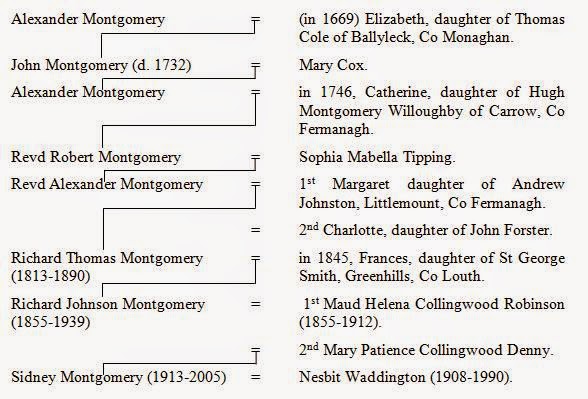
Sir Henry Tichborne of Beaulieu who was created Lord Ferrard in 1715 married in 1683, Arabella Cotton. Their two sons, Henry and William, did not have male heirs, then Beaulieu passed to their daughter, Salisbury Tichborne, and her husband, William Aston. Their daughter, Sophia Aston, married Thomas Tipping and in turn, their daughter, Sophia-Mabella Tipping, married Revd Robert Montgomery. Thus the family name changed four times in as many generations, from Tichborne to Aston to Tipping to Montgomery. The family name was to remain Montgomery until the late Sidney Montgomery married Nesbit Waddington.

The quartered arms on the monument to Revd Robert Montgomery depict the Montgomery, Willoughby, Cole and Montgomery arms along with the Tipping arms as an inescutcheon of pretence. The Montgomery motto and crest are included. The monument in Monaghan Church of Ireland to Captain Thomas Montgomery (second son of Revd Robert) carries a nine-quartered coat of arms which is also displayed at Beaulieu House. These arms were granted to Thomas’s son, George Samuel Montgomery in 1872. The nine families are Montgomery, Cole, Montgomery (Earl of Mount Alexander), Tipping, Aston, Tichborne, Lyerstrum, Loveday and Bysse. Henry Tichborne’s mother was Judith Bysse. The other families of Lyerstrum and Loveday are further back in the Tichborne pedigree.

The broken lance which forms the Montgomery crest is depicted on the plaque to Willoughby Montgomery. The crest was adopted in memory of the tournament of 10 July 1559 when Gabriel Montgomery had the misfortune to accidentally kill the French King Henry II. The Montgomery motto is ‘Patriae infelici fidelis’ (‘faithful to an unhappy country’).


BIBLIOGRAPHY

 
Burke, B.                     1884    General Armory of England, Scotland, Ireland and

Wales, London.

Fleming, W.E.C.         2001    Armagh Clergy 1800-2000, Dundalk.
 

ACKNOWLEDGEMENTS
 
Ms Cara Konig-Brock, her late mother and grandmother, Mrs Gabriel Konig and Mrs Sidney Waddington respectively, Declan Quaile and Noel Ross.


APPENDIX 1: MONTGOMERY PEDIGREE


APPENDIX 2: FAMILY COATS OF ARMS

Aston              Argent a fess and in chief three lozenges sable.
 

Bysse               Sable three escallops in pale argent.
 

Cole                Argent a bull passant sable armed and unglued or, within a bordure or charged with eight bezants, on a canton sinister per pale gule and azure a harp gold, stringed of the field.


Donagh           Per chevron invected or and vert, in chief two lions passant guardant gules in base a boar passant argent armed and bristled or, langued gules.
 

Johnston         (exemplified to Revd Alexander Montgomery, of Beaulieu, Co Louth) Argent a saltire sable between three shamrocks slipped, and in base a human heart ensigned with an imperial crown proper, on a chief gules three cushions or.
 

Loveday         Azure, three bars dancettée or.
 

Lymerston      Argent three eagles displayed gules a bordure azure charged with eight bezants.
 

Montgomery  (Earl of Mount Alexander, extinct 1757) Quarterly, 1st and 4th azure three fleurs-de-lis or, for Montgomery; 2nd and 3rd gules, three annulets

or, gemmed azure, for Eglington, all within a bordure gold, charged with a double tressure flory counterflory gules on a surcoat of the last a

sword and sceptre saltireways proper.
 

Montgomery  (confirmed to Major-General George Samuel Montgomery C.S.I.)

Gules two spears in saltire between three fleurs-de-lis in chief and as

many annulets in base or, stoned azure.
 

Tichborne      (Baron Ferrard, extinct 1731) Vair a chief or, a mullet for difference.
 

Tipping           (Beaulieu, Co Louth) Azure three sceptres erect or, on a canton gules a

dove with an olive branch in the beak all proper.
 

Tipping           Azure a chevron between three sceptres bendways or, on a canton argent a dove with an olive branch in the beak all proper.
 

Willoughby    Or, fretty azure.


The multi-quartered arms 1. Montgomery, 2. Cole, 3. Montgomery, 4, Tipping, 5. Aston, 6. Tichborne, 7. Lyerstrum, 8. Loveday, 9. Bysse